Choosing the right analytical balance can have a direct impact on weighing accuracy, laboratory productivity, data management, and day-to-day workflow. OHAUS offers several laboratory balance families, but the Explorer and Pioneer series are two popular choices for users who need reliable analytical weighing. While both product lines can provide high-resolution measurements, they are designed for different laboratory requirements. The OHAUS Explorer is positioned toward advanced laboratory workflows, offering sophisticated operation, connectivity, automatic calibration, and data-management capabilities. The OHAUS Pioneer, on the other hand, focuses on dependable essential weighing performance with a simpler interface and a more economical approach. Understanding these differences can help laboratories select an analytical balance that provides the right combination of accuracy, functionality, usability, and long-term value.
Quick Overview Of Ohaus Analytical Balances
OHAUS analytical balances are designed for applications where small differences in sample mass need to be measured accurately and consistently. Depending on the model, analytical balances can provide readability down to 0.1 mg, while higher-resolution semi-micro models can go even further. These instruments are commonly used in research laboratories, pharmaceutical facilities, quality-control departments, universities, chemical laboratories, and other settings, and OHAUS balances are widely recognized across different laboratory environments and laboratory environments such as research, pharmaceutical, educational, and quality control labs. Features such as draft shields, calibration systems, stability controls, multiple weighing applications, and digital connectivity can help users reduce errors, support precise measurements, and improve overall data quality.
The main difference between OHAUS Explorer and Pioneer is not simply weighing capability. The decision also involves workflow requirements. Explorer models are designed for laboratories that can benefit from a more advanced touchscreen interface, automatic calibration, extensive connectivity, user management, and sophisticated weighing applications. Pioneer analytical balances concentrate on the essential functions many laboratories use every day, which suits routine laboratory work and routine weighing applications, making them attractive for educational laboratories and organizations looking for dependable performance without paying for features they may rarely use. Its simpler interface also supports user-friendly operation for laboratory professionals.
Lab Balances And Analytical Balances: Key Selection Criteria
Before comparing Explorer and Pioneer directly, it is important to determine what your laboratory actually needs from a balance, and some labs may be deciding between analytical balances and precision balances depending on the level of high precision measurements required. Capacity and readability should be among the first specifications considered. A balance must accommodate the largest samples and containers used in your workflow while still providing sufficiently fine readability for the smallest meaningful weight changes. For many analytical applications, 0.1 mg readability is a common requirement, but specialized applications may call for a semi-micro balance based on the lab's specific requirements.
Repeatability, linearity, stabilization, calibration method, and the laboratory environment should also be considered. A highly capable analytical balance can still produce inconsistent measurements if it is installed near conditions shaped by environmental factors such as vibration, strong air movement, temperature changes, or static electricity, all of which can reduce measurement accuracy and contribute to measurement drift. The balance should therefore be selected as part of the entire weighing process rather than solely by comparing maximum capacity.
Workflow is another important consideration, and balance selection should reflect how the lab operates as well as any compliance requirements tied to records and workflows. Laboratories performing straightforward weighing may need little more than a dependable analytical balance with convenient calibration and basic data transfer. Facilities running multiple applications, maintaining detailed records, managing numerous users, or integrating instruments with digital laboratory systems may benefit substantially from more advanced features. This distinction is one of the most important factors when deciding between the OHAUS Explorer and Pioneer.
Ohaus Analytical Balances: Explorer Series (Advanced Technology)
The OHAUS Explorer family is designed for demanding laboratory applications where weighing performance is only one part of the requirement. Current Explorer EXR analytical models combine high-resolution weighing with a large 7-inch color touchscreen, digital leveling, touchless sensors, automatic AutoCal calibration, and an anti-static glass draft shield with advanced draft shield designs, including a static removal bar at the top of the draft shield for static control in challenging environments. The interface is designed to simplify instrument setup and help users move efficiently between different weighing applications.

Connectivity is another major advantage of the Explorer platform. Current Explorer EXR models provide USB host, USB device, RS232, and Ethernet connectivity, with wireless connectivity available through optional accessories on applicable configurations. This flexibility and these advanced connectivity options can be particularly useful in laboratories that need seamless integration with laboratory information management systems, supporting data logging, data traceability, and data integrity when transferring weighing data to computers, printers, or other information-management systems rather than recording results manually.
Explorer also supports a broader selection of weighing functions. Depending on the model, applications can include basic weighing, parts counting, check counting, percent weighing, check weighing, dynamic weighing, totalization, formulation, differential weighing, density determination, and peak hold. Features such as user management and internal system logging are key features that support regulatory compliance in regulated environments and highly regulated environments, further increasing the appeal of Explorer for laboratories with structured operating procedures or more complex data-management requirements.
Automatic calibration is another practical advantage. Explorer's AutoCal system and internal calibration options can help maintain weighing performance without requiring the operator to perform every calibration adjustment manually, including during temperature changes and in demanding laboratory environments. For busy laboratories where environmental conditions may change or multiple operators use the same balance, this capability can simplify routine operation.
Overall, Explorer makes the most sense when a laboratory wants an analytical balance that goes beyond basic measurement. Research facilities, advanced quality-control laboratories, pharmaceutical environments, and organizations moving toward digitally connected workflows may find its additional capabilities valuable, especially since Explorer balances are designed for environments with strict regulatory documentation requirements.
Ohaus Analytical Balances: Pioneer Series (Lab Balances, Value)
The OHAUS Pioneer PX series takes a different approach. Instead of emphasizing an extensive collection of advanced features, Pioneer focuses on essential weighing functionality, reliable performance, durable construction, robust construction, and straightforward operation at an accessible price point for budget-conscious labs. This makes it a strong option for laboratories that require accurate analytical measurements but do not necessarily need the advanced workflow capabilities available with Explorer.
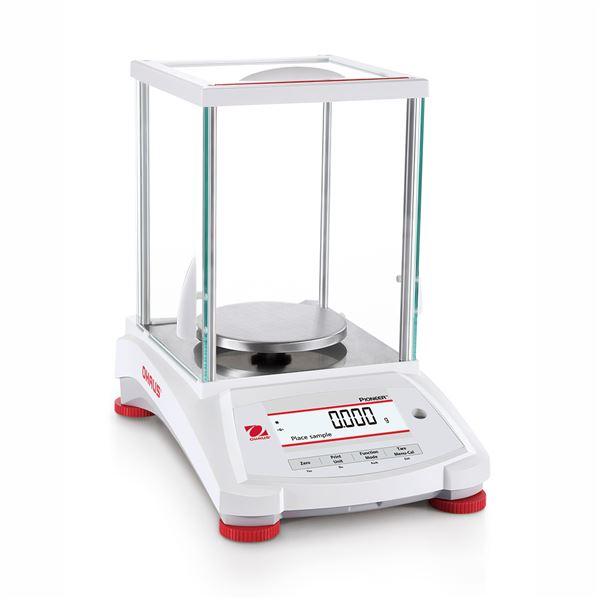
For example, Pioneer analytical models such as OHAUS PX224 Pioneer Analytical Balance provide a capacity of 220 g with 0.1 mg readability. Pioneer models use a backlit LCD with a second display line that provides additional information and operating guidance. This user friendly interface, with intuitive controls and practical user friendly features, can be advantageous in multi-user labs where operators primarily need routine weighing functions.

The Pioneer platform is not limited to basic weight measurement. Depending on the model, applications include basic weighing, parts counting, percent weighing, animal weighing, density determination, and formulation. USB and RS232 communication are also available, covering essential data-transfer needs without the advanced compliance features found in more premium models.
Construction is another important Pioneer advantage. The analytical models use a cast metal lower housing, removable stainless-steel weighing pan, and glass draft shield, which contributes to stability and long-term durability. These characteristics make Pioneer suitable for routine use in laboratory, industrial, and educational environments.
Pioneer models are available in different configurations, so calibration requirements should be checked carefully before purchasing. Some configurations use external calibration, while other applicable Pioneer configurations may offer internal calibration. Laboratories should therefore compare the exact model number rather than assuming every balance within the series has identical calibration features.
For laboratories primarily performing routine analytical weighing, Pioneer can provide an excellent balance between performance and cost. It is a practical choice for routine laboratory work in different laboratory environments where premium instruments are unnecessary.
Side-by-Side Comparison: Explorer vs Pioneer Analytical Balance
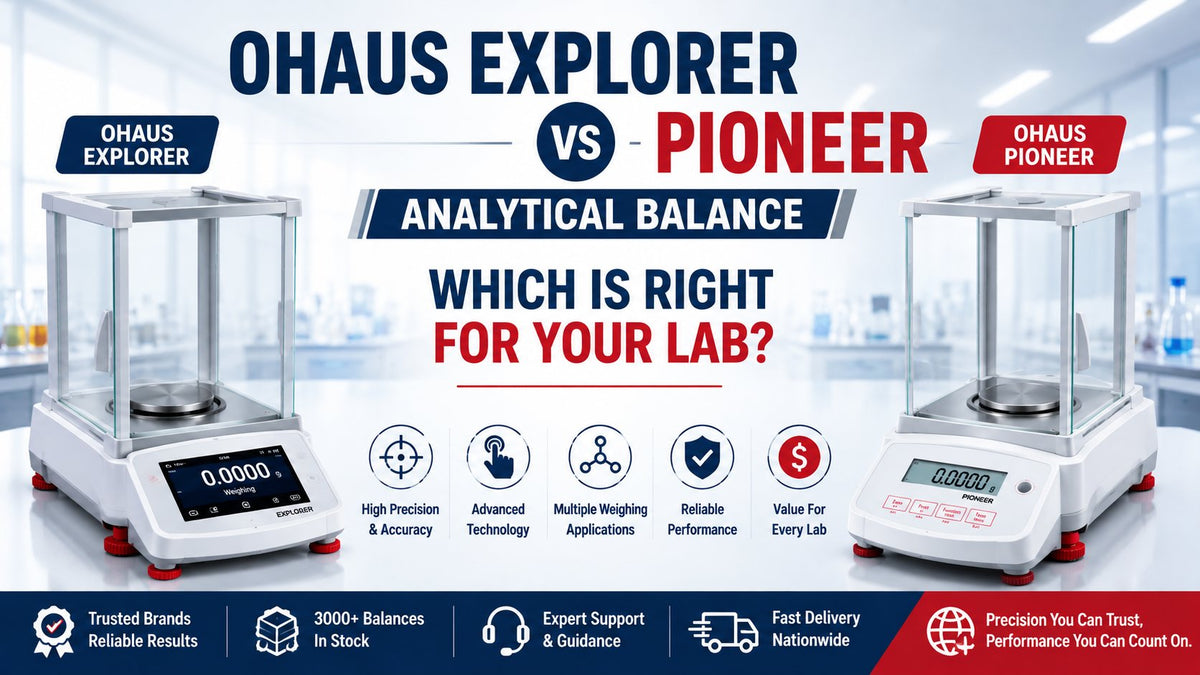
When Explorer and Pioneer are compared directly, both Ohaus scales support precise measurements, but they target different workflows. Explorer is the more technology-focused option, while Pioneer emphasizes essential performance and value.
An OHAUS EXR124 Explorer Analytical Balance may provide the same fundamental 0.1 mg readability found on comparable Pioneer analytical models, but Explorer adds capabilities that can significantly change the user experience. Its large color touchscreen, automatic calibration, digital leveling, touchless operation, advanced connectivity, broader application library, user-management features, and system logging make it better suited to complex workflows. Explorer also supports applications such as density determination, formulation, and percentage weighing, and those added capabilities help support reproducible science and stronger data quality.
Pioneer provides a more traditional balance experience. Its backlit two-line LCD is less sophisticated than Explorer's touchscreen, but that simplicity can actually be beneficial for laboratories where operators repeatedly perform the same basic procedures. Pioneer still offers useful weighing applications and USB and RS232 connectivity, so choosing the lower-cost platform does not necessarily mean giving up essential laboratory functionality.

The practical comparison therefore comes down to how the instrument will be used. If your primary requirement is dependable analytical weighing and your laboratory has relatively straightforward procedures, Pioneer may deliver better value for budget-conscious labs. If your balance will become part of a more sophisticated laboratory workflow involving numerous applications, users, records, and connected systems, Explorer can justify the additional investment for specialized applications.
Best Analytical Balance For Different Lab Types
Research and development laboratories frequently benefit from the OHAUS Explorer because experiments may require multiple weighing methods, flexible configurations, convenient data transfer, and advanced instrument controls, especially in workflows such as chemical analysis. A balance that can support different applications from one interface can improve efficiency when research procedures change regularly.
Pharmaceutical and highly structured quality-control laboratories may also favor Explorer, particularly when user management, traceability, system records, connectivity, and advanced compliance features are important considerations in labs with strict regulatory compliance needs. These environments should always evaluate the exact instrument configuration against their own quality system and regulatory requirements rather than assuming that purchasing a particular balance automatically establishes compliance.
Educational laboratories, teaching facilities, and many routine testing environments may find Pioneer more practical. Students and technicians can quickly understand the simpler interface, which supports user friendly operation in teaching settings, while the instrument still delivers the fine readability needed for analytical weighing. The more economical design can also make it easier for institutions to equip multiple workstations.
Different laboratory environments have different needs, so routine industrial laboratories can choose either series depending on workflow complexity. A facility primarily checking samples and performing standard measurements may be well served by Pioneer. A laboratory that performs formulation, detailed quality-control procedures, complex measurements, or extensive electronic data transfer may gain more from Explorer. Food testing and quality control labs often prioritize workflow efficiency, measurement consistency, and documentation when choosing between the two series.
Buying Checklist For Laboratory Balance Purchases
Start your buying decision by identifying the required capacity and readability. Do not select a balance simply because it offers the highest capacity or finest resolution available. The specifications should correspond to the actual samples, containers, tolerances, and procedures used in your laboratory. Also consider repeatability, linearity, and stabilization time because readability alone does not describe overall weighing performance in busy labs.
Next, determine your calibration requirements. If minimizing manual calibration procedures is important, an Explorer model with AutoCal can be particularly attractive. If external calibration is acceptable, an applicable Pioneer configuration may provide the performance you need at a lower initial investment. Always confirm the calibration method of the specific model before ordering.
Consider the number of users and complexity of daily operations. For lab managers choosing for multi-user workflows, a laboratory with many operators, advanced applications, or detailed record-management requirements can benefit from Explorer's advanced interface and management features. A smaller laboratory performing repetitive routine measurements may not receive enough benefit from those features to justify choosing them over Pioneer.
Connectivity should also be evaluated before purchase. Think about where measurement data must go after the weighing process. If results need to move frequently between the balance, computer systems, networks, printers, or other equipment, Explorer's expanded connectivity can be valuable, including seamless integration with laboratory information management systems when required. If straightforward USB or RS232 communication is sufficient, Pioneer may meet the requirement.

Finally, consider the total value of the balance over its working life rather than focusing only on purchase price. Productivity, calibration convenience, operator training, data transfer, workflow efficiency, accessories, and future laboratory requirements can all affect the real cost of ownership.
Final Recommendation: Choosing Between Explorer And Pioneer
There is no single winner in the OHAUS Explorer vs Pioneer comparison because the better analytical balance depends on the laboratory. The OHAUS Explorer is the stronger choice for laboratories that need advanced technology, automatic calibration, touchscreen operation, extensive connectivity, multiple weighing applications, user-management capabilities, and more sophisticated data workflows. Its broader feature set makes it particularly attractive among premium models for labs that need ultra high precision, superior sensitivity, and advanced compliance features. It is also better suited to demanding laboratory environments and regulated environments where productivity and digital integration are important.
The OHAUS Pioneer is an excellent choice for laboratories that prioritize accurate routine weighing, straightforward operation, durability, and overall value. It is particularly well suited to educational laboratories, routine testing, basic quality control, and organizations that need reliable analytical weighing at an accessible price point for routine laboratory work without investing in functionality they may not use.
Before making a final decision, compare the exact Explorer and Pioneer models rather than selecting solely by series name. Capacity, readability, calibration type, connectivity, applications, and other specifications can vary between models. Matching those specifications to your lab's specific requirements and how the lab operates will help you choose an analytical balance that delivers dependable measurements while providing the best long-term value for your budget.
Frequently Asked Questions
Which brand is considered the best for analytical balances?
There is no single analytical balance brand that is best for every laboratory. Leading manufacturers such as OHAUS, Sartorius, Mettler Toledo, A&D Weighing, and RADWAG are widely used for precision laboratory weighing. The best choice depends on required readability, capacity, calibration method, compliance needs, connectivity, available features, and budget. For laboratories seeking advanced features and reliable analytical performance, OHAUS Explorer models are a strong option, while other brands may be better suited to specific applications or price ranges.
Is OHAUS a good brand for scales?
Yes. OHAUS is a well-established manufacturer of laboratory balances and industrial scales, with products designed for applications ranging from routine weighing to high-precision analytical measurements. OHAUS offers analytical, precision, portable, bench, counting, and other weighing instruments. Its Explorer and Pioneer laboratory balance families are popular choices for users who want reliable weighing performance with different levels of features and automation.
Which is more accurate, triple beam balance or analytical balance?
An analytical balance is significantly more precise than a traditional triple beam balance. Triple beam balances are typically intended for general measurements where very fine resolution is not required, while analytical balances can commonly provide readability of 0.0001 g (0.1 mg). This makes analytical balances much better suited to pharmaceutical, chemical, research, formulation, and quality-control applications where very small changes in mass must be measured reliably.