
Key Takeaways
Each model serves distinct needs, so understanding their differences is critical before making a purchase decision.
-
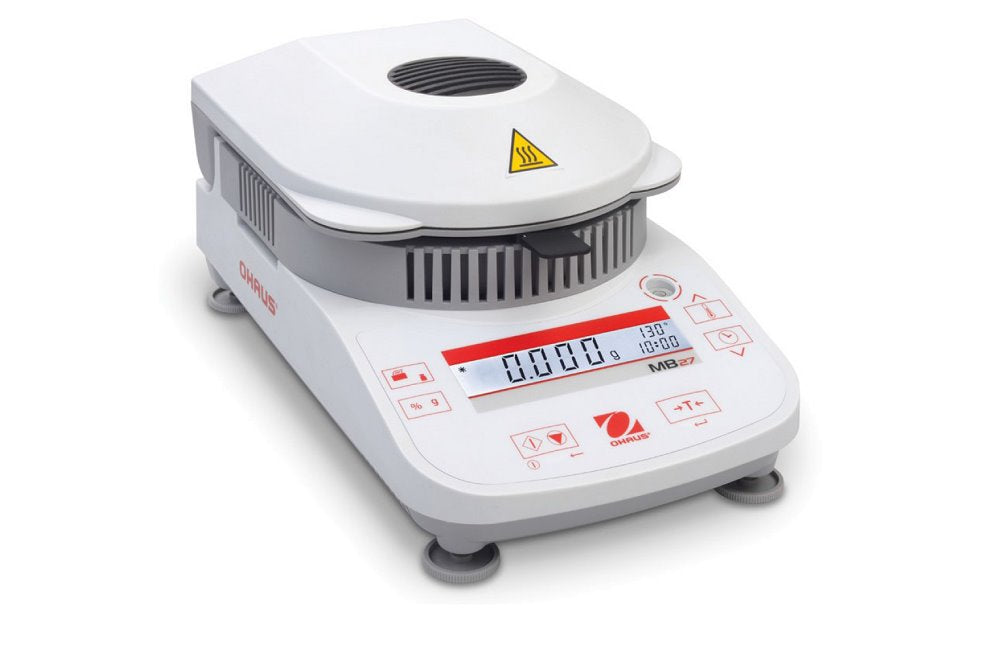
MB23 is the most economical option, designed as an entry-level model for routine moisture testing with a large backlit LCD display, basic functionality, and 0.1% moisture readability—ideal for straightforward checks where ultra-high precision isn’t critical.
-
MB92 bridges the gap with a color capacitive touchscreen, carbon fiber heating technology, improved 0.01% readability moisture content, flexible drying profiles, and enhanced password protection for QC and R&D labs needing better data handling.
-
MB120 is the flagship model offering outstanding performance flexible configuration, method creation tools like SmartGuide, advanced statistics, and robust RS232 USB host connectivity for high-throughput and regulated environments.
-
All three OHAUS moisture analyzers support applications in food, pharma, chemicals, soils, and wastewater, but differ significantly in maximum capacity, temperature range, and workflow features.
-
Your choice should be driven by sample type, required accuracy, throughput volume, documentation requirements, and budget—not just price point.
Introduction to OHAUS MB Moisture Analyzers
Moisture content analysis is a critical quality control function across industries. Whether you’re testing grains in food processing, verifying pharmaceutical intermediates, analyzing soil samples, or checking chemical raw materials, knowing the exact moisture content determines product quality, shelf life, and regulatory compliance.
The OHAUS MB series represents a family of laboratory moisture analyzers designed to determine moisture content quickly and reproducibly using thermogravimetric (loss-on-drying) principles. These instruments heat a sample while continuously measuring weight loss until a stable endpoint is reached—giving you accurate results in minutes rather than the hours required by traditional oven methods.
Each model uses a different heating system optimized for its intended user base, with the MB23 using glass less infrared heating, the MB92 featuring new carbon heating technology, and the MB120 employing halogen heating for superior thermal performance.
Quick Comparison: MB23 vs MB92 vs MB120
Before diving into the details, here’s the fast way to see the practical differences between these three OHAUS products at a glance.
|
Specification |
MB23 |
MB92 |
MB120 |
|---|---|---|---|
|
Maximum Capacity |
110 g |
90 g |
120 g |
|
Readability |
10 mg / 0.1% |
1 mg / 0.01% |
1 mg / 0.01% |
|
Recommended Moisture Range |
Basic applications |
0.5% to 100% |
0.5% to 100% |
|
Heating Technology |
Infrared coil |
Carbon fiber heating |
Halogen lamp |
|
Temperature Range |
50°C to 160°C |
40°C to 200°C |
40°C to 230°C |
|
Drying Profiles |
Standard only |
4 profiles (Ramp, Standard, Step, Fast) |
4 profiles + advanced customization |
|
Display Type |
Backlit LCD |
Full-color capacitive touchscreen |
4.3” TFT color touchscreen |
|
Shut-Off Criteria |
Basic |
Multiple options |
7 customizable criteria |
|
Method Storage |
Limited |
Enhanced |
100 methods / 1,000 stored results |
|
Connectivity |
RS232 |
RS232 USB host, USB device |
RS232 USB (GLP/GMP), dual USB host |
|
Pan Size |
3.5 in 90 mm |
3.5 in 90 mm |
3.5 in 90 mm |
Quick Positioning Summary:
-
MB23 = Entry level for routine moisture checks
-
MB92 = Advanced routine and QC with better precision
-
MB120 = High-end, method-driven, compliance-focused
OHAUS MB23 Moisture Analyzer – Entry-Level Routine Testing
The MB23 is OHAUS’s affordable, reliable choice for laboratories and production lines that need routine moisture checks without advanced data management or complex method programming. It delivers precise moisture content determination at an unbeatable value.
Capacity and Readability
With a maximum capacity of 110 grams and readability of 10 mg (0.1% moisture), the MB23 handles common products like grains, powders, and basic food ingredients effectively. While the 0.1% resolution is lower than the MB92 and MB120, it’s entirely adequate for applications where distinguishing between 5.0% and 5.1% moisture is sufficient for your quality requirements.
Heating System and Temperature
The MB23 uses infrared heating elements with a temperature range of 50°C to 160°C. This range covers many standard loss-on-drying methods, though it limits flexibility for samples requiring higher temperatures or more gentle ramp-up profiles.
User Interface and Operation
The line display features a backlit LCD with membrane keys, designed for easy operation and minimal training. Operators can start running samples within minutes of reading the user guide—no extensive training required.
The MB23’s straightforward interface makes it ideal for facilities where multiple operators with varying skill levels need to run samples quickly.
Ideal Applications for MB23
-
Incoming raw material checks in food production
-
Simple in-process moisture control
-
Basic QA in small food producers or bakeries
-
Educational laboratories with limited budgets
-
Quick spot-checks on the production floor

Limitations to Consider
The MB23 offers fewer drying profiles and limited method storage compared to MB92 and MB120. It’s better suited to labs running only a handful of simple methods rather than facilities requiring extensive method libraries.
For maintenance, the MB23 features durable construction with robust ABS housing and a metal pan support. The sample pan is easy to clean, though it lacks the tool free cleaning advanced chamber design found in higher-end models.
OHAUS MB92 Moisture Analyzer – Precision and Flexibility
The MB92 represents a mid-range, high-precision analyzer bridging the gap between basic instruments and fully featured lab moisture analyzers. It’s designed for users demanding better resolution and workflow capabilities without the full complexity of the flagship model.
Capacity and Precision
Operating at 90 grams capacity with readability of 1 mg (0.01% moisture content), the MB92 supports a recommended moisture range from 0.5% to 100%. This ten-fold improvement in resolution over the MB23 makes it suitable for more samples with tighter specifications.

Carbon Fiber Heating Technology
The MB92 incorporates carbon fiber heating technology—a significant advancement over traditional infrared heating. This technology and an upgraded thermal system provides:
-
Faster heat-up times
-
More uniform heating across the sample
-
Better temperature stability during analysis
-
Extended temperature range of 40°C to 200°C
Four Drying Profiles
The MB92 includes four drying profiles that allow users to optimize drying behavior:
|
Profile |
Best For |
|---|---|
|
Standard |
General-purpose moisture testing |
|
Fast |
Robust samples with high moisture |
|
Ramp |
Thermally sensitive samples requiring gradual heating |
|
Step |
Complex samples needing multi-stage temperature programs |
Shut-Off Criteria Options
Multiple shut off criteria options (Timed, Manual, Auto, and custom settings) enable more reproducible endpoints compared with basic fixed-time methods. You can define exactly when analysis terminates based on weight stability, ensuring consistent results across operators and shifts.
User Interface Upgrades
The full-color capacitive touchscreen provides intuitive navigation and graphical feedback, reducing training time and operator error. The drying curve displays in real-time, allowing operators to monitor the whole process visually.
Sample Identification and Traceability
Enhanced sample id and traceability features include:
-
Sample name fields
-
Batch ID tracking
-
Method name storage
-
Results linked to specific sample identifications
These can be entered directly from the touchscreen and stored with results, supporting better documentation for quality control requirements.
Construction and Easy Maintenance
The MB92 features durable PBT housing and tool free cleaning assembly that simplifies routine maintenance. The multi color status light provides at-a-glance indication of analysis status—particularly useful in busy labs processing more samples throughout the day.
Ideal User Profiles for MB92
-
QC labs in food and beverage manufacturing
-
Specialty chemical production facilities
-
Animal feed testing laboratories
-
Materials testing labs needing method flexibility
-
Teams requiring better traceability without MB120’s complexity

OHAUS MB120 Moisture Analyzer – Advanced, Method-Driven Performance
The MB120 is positioned as the flagship moisture analyzer in the OHAUS MB series, designed for demanding applications with high sample throughput, strict documentation needs, or regulated environments requiring comprehensive audit trails.
Capacity, Resolution, and Beyond
With 120 grams maximum capacity and 1 mg / 0.01% readability, the MB120 matches the MB92’s resolution while offering greater sample capacity. However, its primary advantage isn’t just measurement precision—it’s the workflow-oriented software and method management capabilities.
Halogen Heating System
The MB120 uses a halogen lamp heating system providing:
-
Superior heating speed and efficiency
-
Broadest temperature range at 40°C to 230°C
-
Better thermal response for complex drying profiles
-
Capability to analyze materials requiring higher thermal processing
Advanced Method Storage
Where the MB120 truly distinguishes itself is storage capacity:
-
100 user methods with predefined temperatures, shut off criteria, and calculation settings
-
1,000 measurement results stored with full traceability
-
Methods can be exported and shared across multiple devices
-
Configuration and reliable results transfer between instruments
For organizations with multiple testing locations, the MB120’s method sharing capability ensures standardized analysis procedures across all sites.
Seven Customizable Shut-Off Criteria
The MB120 provides seven different shut off criteria options:
-
Manual
-
Timed
-
Auto-free %/s
-
Auto-free mg/s
-
A30
-
A60
-
A90
This flexibility allows precise control over when analysis terminates, preventing sample degradation from excessive heating while ensuring reliable results across different sample types.
SmartGuide Method Creation
The MB120 features SmartGuide™ software—a revolutionary tool that automatically analyzes a sample and creates a method. This eliminates guesswork from initial setup, reducing operator training time and improving consistency across analyses. Instead of manually optimizing temperature and time parameters through trial and error, SmartGuide performs efficient moisture analysis automatically.
Integrated Statistics and Reporting
Built-in statistical functions calculate:
-
Mean moisture values
-
Standard deviation
-
Minimum and maximum across batches
-
Batch-to-batch comparisons
These calculations happen automatically, supporting faster smarter more efficient quality decisions.
Connectivity for Compliance
The MB120 offers comprehensive connectivity:
|
Port |
Function |
|---|---|
|
RS232 (GLP/GMP) |
Compliant data output for regulated industries |
|
USB device |
Direct PC connection |
|
USB host (x2) |
Printer connection, data export, method transfer |
This connectivity supports integration into LIMS systems and digital recordkeeping workflows essential for pharmaceutical, food safety, and other regulated environments.
Operational Language Support
Supporting 14 operational languages, the MB120 serves global markets and diverse laboratory environments—particularly valuable for multinational organizations with multilingual staff.
Key Application Scenarios for MB120
-
High-throughput QC laboratories
-
R&D labs optimizing new formulations
-
Pharmaceutical environments with strict SOPs
-
Medical device manufacturing
-
Plants requiring robust documentation for audits
-
Multi-site organizations needing harmonized methods

Heating Technology, Drying Profiles, and Performance Considerations
While all three models perform moisture analysis through loss-on-drying principles, how they manage temperature and time significantly impacts drying speed, sample integrity, and repeatability.
Understanding Drying Profile Type
The four drying profiles available on MB92 and MB120 serve distinct purposes:
Standard Profile: Maintains constant temperature throughout—suitable for most routine moisture testing applications.
Fast Profile: Applies higher initial heat for faster results on robust samples that won’t degrade under aggressive heating.
Ramp Profile: Gradually increases temperature over time—essential for thermally sensitive samples that might crust or decompose if heated too quickly.
Step Profile: Uses multiple temperature stages—ideal for complex matrices requiring different heating phases to drive off bound and free moisture separately.
The Speed vs. Integrity Trade-Off
Higher temperatures deliver faster results but risk sample degradation, crusting, or incomplete moisture release. The advanced features available on MB92 and MB120 make it easier to find the right balance through customizable methods, while MB23 users work within more limited parameters.
Performance Factors
For high performance moisture analysis, consider these factors:
-
Repeatability: MB92 demonstrates 0.08% (3g samples) and 0.015% (10g samples)
-
Warm-up time: Halogen systems reach operating temperature faster
-
Chamber design: Higher-end models maintain more stable internal environments
Choosing the Right OHAUS Moisture Analyzer for Your Application
Model selection should be driven by sample type, required accuracy, throughput, documentation needs, and budget—rather than price alone. Each OHAUS MB model serves specific use cases effectively.
When MB23 is the Best Choice
-
Low sample volumes with infrequent use
-
Limited budget with basic functionality needs
-
Simple raw material checks without tight specifications
-
Educational labs teaching moisture analysis fundamentals
-
Non-regulated contexts where documentation requirements are minimal
-
Facilities running only 1-2 standard methods
When MB92 is Ideal
-
Mid-size QC labs with moderate sample throughput
-
Routine release testing requiring 0.01% resolution
-
Multiple product lines with different drying requirements
-
Teams needing better traceability without MB120’s complexity
-
Environments valuing durability and flexible performance
-
Labs transitioning from basic to more sophisticated analysis with advanced features
When MB120 is Recommended
-
High-throughput operations processing many samples daily
-
Pharmaceutical or tightly regulated industries (GMP/GLP)
-
Multi-site organizations needing harmonized, transferable methods
-
Labs requiring strong digital data management and audit trails
-
R&D environments developing and validating new methods
-
Facilities where variety of moisture applications demands flexible configuration and reliable results
Practical Selection Guidance
-
Operator skill level: MB23 requires minimal training; MB120’s features benefit experienced users
-
Calibration frequency: All models need routine verification, but MB92 and MB120 offer guided calibration menus
-
Bench space: MB23 has the smallest footprint; MB120 requires more room
-
Frequent use patterns: Higher-end models justify their cost in high-volume environments
Frequently Asked Questions
Can I use the same drying method on MB23, MB92, and MB120?
In many cases, a basic method specifying temperature, time, or automatic shut-off can be replicated across all three instruments. However, MB92 and MB120 allow more precise control through additional drying profiles and customizable shut-off criteria that may improve accuracy and repeatability. When transferring methods between models, conduct a short validation study comparing results—especially for critical products or regulatory applications where method equivalence must be demonstrated.
How often should I calibrate or verify my moisture analyzer?
Routine balance calibration and temperature verification should occur based on usage intensity. Busy QC labs typically verify monthly, while lower-volume environments may verify quarterly. Always follow your internal QA procedures and any applicable regulatory requirements. MB92 and MB120 offer guided calibration menus that simplify routine checks using certified weights and optional temperature calibration kits, making the manual process more straightforward.
What types of samples are not suitable for halogen moisture analyzers?
Highly volatile, explosive, or easily combustible materials may not be suitable for halogen or infrared heating and require alternative moisture determination methods. Strongly temperature-sensitive samples that decompose below typical analysis temperatures need lower temperatures and gentler ramp profiles—easier to configure on MB92 and MB120 than on MB23. Samples containing components that sublimate rather than evaporate may also give misleading results with thermogravimetric methods.
Do I need a printer or PC connection with my moisture analyzer?
Small labs performing occasional checks may be comfortable with manual transcription of results, especially with MB23’s straightforward display. However, labs working under ISO, GMP, or similar standards benefit significantly from connecting MB92 or MB120 to a printer or PC. Automatic documentation reduces transcription errors, provides audit trails, and simplifies compliance during inspections. The MB120’s GLP/GMP-compliant RS232 output is specifically designed for regulated environments.
How long does a typical moisture analysis run take?
Most routine tests finish within 5-15 minutes, depending on moisture content, sample mass, and temperature settings. High-moisture samples or thermally sensitive materials requiring lower temperatures may need 20-30 minutes or longer. MB92 and MB120 can shorten method development time by allowing users to fine-tune profiles and shut off criteria—finding the fastest reliable method rather than using conservative generic settings. The SmartGuide feature on MB120 accelerates this optimization process significantly.