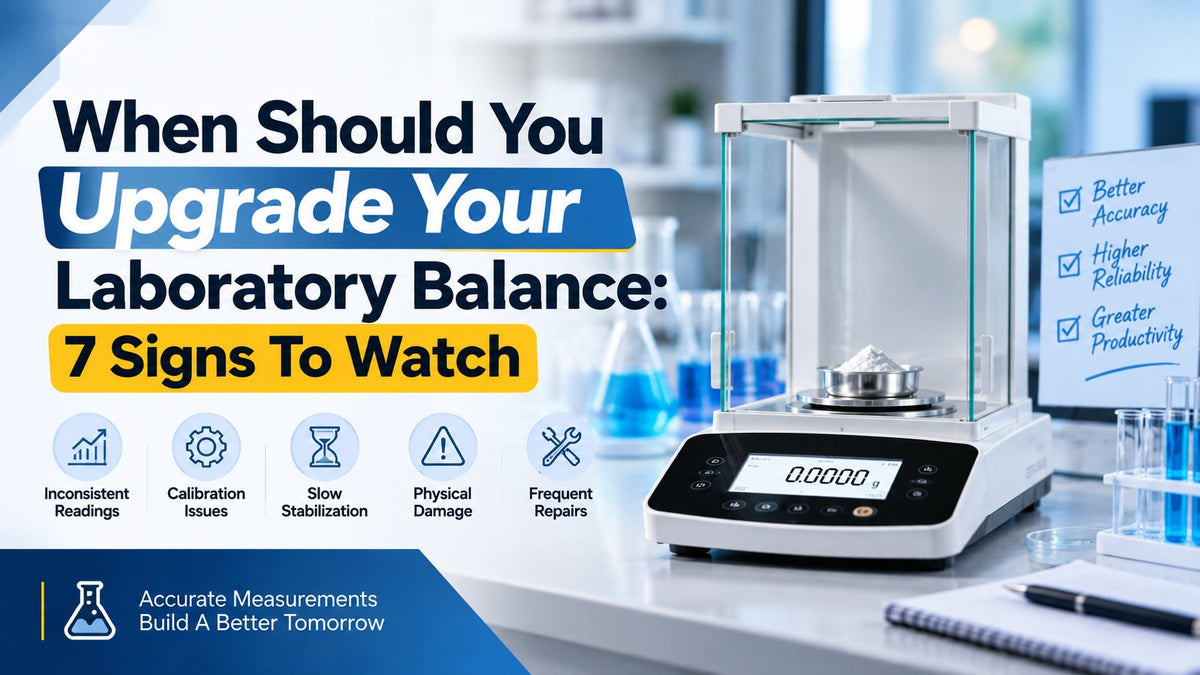
A reliable laboratory balance is essential whenever accurate mass measurements affect research, formulation, quality control, sample preparation, or routine laboratory work. Even a high-quality lab balance does not remain in perfect condition forever. Normal wear, environmental exposure, repeated use, accidental overloads, component aging, and changing laboratory requirements can eventually affect its performance. Because weighing errors can carry through an analytical process, problems with a balance should not be ignored.
However, an unusual reading does not automatically mean that you need a new laboratory balance. Drafts, vibration, static electricity, temperature changes, an unstable work surface, incorrect leveling, contamination, or calibration issues can also cause poor weighing performance. Routine testing and professional calibration help determine whether a balance remains fit for its intended purpose.
Knowing the warning signs can help your laboratory decide whether basic troubleshooting, calibration, professional balance service, or replacement is the most appropriate next step.
7 Signs Your Lab Balance May Need Replacement
Laboratory balance problems often develop gradually rather than appearing as a complete failure. You may notice that results take longer to settle, repeated measurements become inconsistent, calibration problems return after service, or maintenance requirements increase. These symptoms should be investigated because repeatability, sensitivity, calibration, and reliable operation are fundamental to dependable laboratory weighing.
One warning sign alone may be repairable. When several problems occur repeatedly, however, and qualified servicing no longer restores acceptable performance, it may be time to evaluate a replacement balance.
Readings Keep Drifting On Laboratory Balances
A stable sample should not produce a display that continually moves without a clear reason. When laboratory balance readings drift, first consider environmental influences. Air currents, vibration, static electricity, temperature changes, insufficient warm-up time, and an unstable installation can all influence sensitive weighing instruments. This often appears as an unstable displayed weight rather than a steady final reading.
Check that the balance is properly leveled, installed on a stable, level surface, protected from drafts and vibration, clean, and operated within the manufacturer's environmental requirements. Allow samples and equipment to acclimatize when appropriate. If persistent drift continues after environmental causes have been addressed and the balance has been professionally inspected and calibrated, the instrument may no longer provide the reliability your application requires.
Same Sample Gives Different Results On Lab Balance
Repeatability describes a balance's ability to provide corresponding results when the same load is repeatedly placed on the weighing pan under the same testing conditions. It is therefore an important indicator of weighing performance.
If the same stable sample repeatedly produces meaningfully different measurements, first check the weighing technique, sample condition, environmental stability, balance cleanliness, leveling, and calibration status. A repeatability test with suitable test weights can provide a more controlled assessment. Routine balance testing commonly includes repeatability alongside sensitivity and eccentricity testing.
If repeatability remains outside the tolerances required for your process even after qualified servicing, continuing to rely on that laboratory balance can introduce unnecessary uncertainty into your results. At that point, replacement may be more appropriate than repeated troubleshooting.

Calibration Failures Keep Returning For Laboratory Balances
Calibration compares the balance indication with known reference values and helps establish confidence in measurement results. Laboratory balances should be calibrated regularly; to maintain accuracy and extend the instrument’s lifespan, follow the manufacturer’s instructions and balance regularly, with frequency determined by applicable requirements and the risk associated with the weighing application.
A single failed calibration does not necessarily mean the balance needs replacement. Adjustment, cleaning, relocation, environmental correction, or professional service may resolve the problem. More concerning is a pattern in which calibration failures repeatedly return after corrective work.
For regulated or high-accuracy applications, recurring calibration failures deserve particular attention. Current USP guidance for quantitative pharmaceutical weighing emphasizes calibration as well as periodic checks of sensitivity and repeatability. If a balance repeatedly cannot stay within the required tolerances after proper service, upgrading to an instrument that meets the laboratory's current accuracy and compliance requirements and offers better reliability may be the better long-term decision.
Balance Takes Too Long To Stabilise On Lab Balances
Stabilization time is the period between placing a sample on the weighing pan and obtaining the final displayed result. Long stabilization times can create bottlenecks in workflows, especially during routine weighing. The expected stabilization time depends on the balance and its settings, and environmental conditions can also affect how quickly a stable reading is achieved.
If a balance that previously stabilized quickly begins taking substantially longer, check for drafts, vibration, unstable surfaces, incorrect filter settings, temperature changes, contamination, and sample-related problems. Sensitive analytical and semi-micro balances can react strongly to small environmental disturbances.
A consistently slow response becomes more significant when it appears together with drift, poor repeatability, calibration problems, or other performance changes. If professional maintenance cannot restore normal operation, a newer balance may reduce weighing delays, improve laboratory productivity, and cut manual tasks.
Unreliable Zeroing Or Tare Functions On Lab Balance
Zero and tare functions are used constantly in routine laboratory weighing. When a balance struggles to return consistently to zero after a load is removed, or when the tare function behaves unpredictably, reliable net-weight measurements become more difficult.
Before assuming hardware failure, make sure the pan is clean and correctly installed, the balance is level, there is no contact between the weighing pan and surrounding components, and environmental conditions are stable. Restarting the balance according to the manufacturer's instructions and performing the appropriate adjustment or calibration may also help.
If zero or tare instability continues after proper inspection and service, the problem should not simply be worked around. A laboratory balance needs to perform within the tolerance required by its application, and routine testing is intended to identify problems before they compromise laboratory processes.
Visible Damage Or Wear To Laboratory Balance Parts
Physical condition matters. Damaged weighing pans, draft shields, doors, displays, keypads, leveling components, cables, connectors, housings, or other parts can interfere with safe and reliable operation. Chemical spills, corrosion, accidental impact, and overloading can also shorten an instrument's useful life, and chemicals should be cleaned promptly because they can damage components or contaminate weighing areas.

Not every damaged component requires an entirely new balance. Replaceable accessories or parts may make repair straightforward and economical. Preventive maintenance commonly includes visual inspection for equipment damage, cleaning with compatible materials, functional checks, leveling checks, and inspection of measurement-related performance.
Replacement becomes more reasonable when critical components are damaged, required parts are obsolete or unavailable, or restoring the instrument would cost too much relative to its remaining useful life and current laboratory requirements.
Frequent Repairs And Maintenance No Longer Restore Performance
Routine maintenance is a normal part of owning laboratory weighing equipment. Professional preventive maintenance helps maintain performance, extend the balance's useful life, reduce downtime, and support consistently reliable results. Therefore, needing maintenance does not by itself indicate that a balance is obsolete.
The situation changes when repairs become frequent and the same performance issues keep returning. Repeated service calls create rising maintenance costs as well as indirect costs from downtime, interrupted workflows, repeated measurements, and staff time.
Keep a maintenance log for each important laboratory balance. Recording calibration outcomes, repairs, downtime, replacement parts, and recurring faults makes it easier to see whether maintenance is preserving a useful instrument or merely postponing replacement, and when continued use is only delaying the decision without preserving value.
Decide To Replace Lab Equipment When Frequent Repairs Hurt
The decision to repair or replace laboratory equipment should consider more than the price of a single service call. Compare the expected repair cost and remaining useful life of the current balance with the cost and capabilities of an appropriate replacement, because replacement is often more cost-effective when frequent failures and maintenance costs keep rising. Consider downtime, frequency of failures, availability of spare parts, calibration performance, staff productivity, and the consequences of inaccurate results.

Preventive maintenance itself is valuable because instrument failure can lead to much larger costs, including downtime, rework, production interruptions, and other process consequences. But once repeated maintenance no longer returns the balance to acceptable performance, spending more on an aging instrument may provide diminishing value.
Changing laboratory requirements are another reason to upgrade even if an older balance still works. Your lab may now require a lower readability, higher capacity, better repeatability, improved data connectivity, internal calibration, additional compliance capabilities, or features that support more efficient workflows, and older technology can limit workflow while outdated connectivity may restrict integration with Laboratory Information Management Systems. In such situations, replacement can be an operational upgrade rather than simply a response to failure, and timely upgrades can be a cost-effective response when an older unit no longer matches current lab needs.
Basic Checks Before Arranging Balance Service
Before arranging professional balance service, perform the basic checks permitted by your manufacturer's instructions and laboratory procedures. Confirm that the balance is level and located on a stable surface. Look for vibration, drafts, direct airflow, temperature changes, static electricity, or other environmental conditions that could affect the reading, and keep precision balances away from heat-generating equipment. Sensitive balances can be strongly influenced by these external factors.
Inspect the weighing pan and surrounding area for contamination or physical obstruction. Make sure the balance has had appropriate warm-up or acclimatization time, and verify that samples are suitable for stable weighing. Review recent changes in location, workflow, room conditions, or operators as possible causes of weighing problems.
You can also perform authorized routine checks using appropriate calibrated test weights and your established SOPs. Depending on the application, routine tests may evaluate repeatability, sensitivity, and eccentricity to help support precise measurements.
Do not treat these checks as a substitute for professional calibration. If the balance continues producing questionable results, fails routine performance criteria, has suffered physical damage, or is used for regulated or critical work, qualified service should evaluate it. Follow the manufacturer's procedures to care for the device properly between service visits.
Choosing Replacement Laboratory Balances And Lab Equipment
When replacement becomes necessary, do not simply purchase the closest modern equivalent of the old instrument. Start by focusing on the measurements and weighing tasks your laboratory actually performs. Determine the maximum capacity you need, the smallest quantity you routinely weigh, required readability, acceptable uncertainty and repeatability, sample characteristics, environmental conditions, and any regulatory or quality-system requirements.
Readability is the smallest mass difference a balance can display. Laboratory weighing options can range from high-capacity and precision balances to analytical, semi-micro, micro, and ultra-micro balances, so selecting the correct class depends on the application rather than simply choosing the balance with the greatest number of decimal places.
For example, a digital balance may be suitable for routine weighing tasks, while more sensitive applications may require a higher-performance class.
Consider calibration requirements as well. Some modern laboratory balances provide motorized internal adjustment, while external calibration requires suitable test weights and additional operator involvement. Traceable calibration may also be required depending on your laboratory's quality or regulatory requirements.
Finally, evaluate practical features such as stabilization speed, draft protection, capacity, interface options, data management, ease of cleaning, service availability, and long-term support. The right solutions should match the lab's workflow, not just the specification sheet. The best replacement laboratory balance is one that is demonstrably fit for its intended weighing process, provides the required measurement performance, and supports efficient daily laboratory work. For example, the OHAUS Explorer EXR224 analytical balance, A&D GH-120 analytical balance, and Sartorius Entris II BCE224-1S analytical balance are replacement options to consider based on the weighing requirements of the application.

Upgrading a laboratory balance at the right time can help prevent recurring downtime and unreliable measurements. Drift, poor repeatability, recurring calibration failures, slow stabilization, unreliable zeroing, physical damage, and escalating repair requirements are all reasons to investigate an instrument's condition. They are not automatic proof that replacement is necessary, but when proper testing and professional service can no longer restore performance within your required tolerances, replacing the balance may be the more practical long-term solution.
Frequently Asked Questions
How do I know when my laboratory balance needs to be replaced?
A laboratory balance may need replacement when readings continually drift, the same sample produces inconsistent results, calibration failures keep returning, stabilization becomes unusually slow, or zero and tare functions become unreliable. Frequent repairs and physical damage can also indicate that replacement should be considered, particularly when professional servicing no longer restores acceptable performance.
Should I repair or replace an old laboratory balance?
Consider the frequency and cost of repairs, downtime, availability of replacement parts, calibration performance, and the remaining useful life of the balance. If repeated maintenance no longer restores reliable performance or repair costs continue increasing, replacing the balance may provide financial and operational benefits, including better reliability and better long-term value.
Why does my laboratory balance keep giving different readings?
Different readings can result from vibration, drafts, temperature changes, static electricity, contamination, incorrect leveling, sample conditions, or calibration problems. If the same stable sample continues producing inconsistent measurements after these factors are addressed and the balance is professionally serviced, poor repeatability may indicate a more serious performance problem.
What should I check before replacing a laboratory balance?
Before replacing the balance, check that it is properly leveled, clean, installed on a stable surface, and protected from drafts, vibration, temperature changes, and static electricity. You should also check its calibration status and perform authorized routine tests with appropriate calibrated test weights according to your laboratory procedures.
What should I look for when buying a replacement laboratory balance?
Choose a replacement based on your required capacity, readability, repeatability, weighing uncertainty, sample characteristics, calibration requirements, and laboratory environment. Also consider stabilization speed, draft protection, internal or external calibration, connectivity, data management, safety, compliance, ease of cleaning, service availability, and long-term support. If you are buying refurbished or outside a new-equipment channel, make sure the balance is properly tested before purchase, as obsolete equipment can become a risk to patient safety in regulated clinical settings.