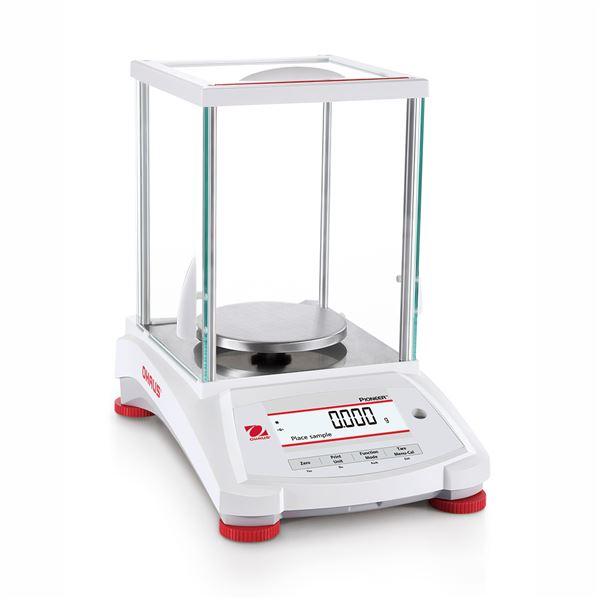
Accurate calibration is essential for maintaining the precision and reliability of analytical balances. The Ohaus PX84/E Pioneer Analytical Balance is designed for high-accuracy laboratory applications and requires external calibration using certified weights.
This guide explains how to properly calibrate the Ohaus PX84/E, following the calibration procedures outlined in the official Ohaus PX Series Instruction Manual, rewritten in a clear, practical, and SEO-optimized format.
Understanding Calibration on the Ohaus PX84/E
The PX84/E is an ExCal (External Calibration) analytical balance, meaning:
-
It does not contain an internal calibration weight
-
Calibration must be performed using external certified calibration masses
-
The balance supports:
-
Span Calibration
-
Linearity Calibration
-
According to the user manual, calibration is required:
-
When the balance is installed for the first time
-
After relocation
-
When environmental conditions change
-
As part of routine quality control or compliance programs
Pre-Calibration Checklist (Critical for Accuracy)
Before starting calibration, ensure all of the following conditions are met:
1. Warm-Up and Acclimatization
-
Allow the PX84/E to warm up for at least 1.5 hours
-
Analytical balances require longer stabilization for accurate results
2. Environmental Conditions
-
Install the balance on a stable, vibration-free surface
-
Avoid drafts, open windows, air conditioning, and direct sunlight
3. Level the Balance
-
Adjust the leveling feet until the bubble indicator is centered
4. Use Correct Calibration Weights
For the Ohaus PX84/E, the official calibration values are:
-
50 g
-
80 g (full capacity)
Use ASTM Class 1 or equivalent certified calibration weights for analytical accuracy.

How to Perform Span Calibration on the PX84/E
Span calibration adjusts the balance using two reference points: zero load and a known calibration mass.
Step-by-Step Span Calibration Instructions
-
Power ON the balance
-
Ensure the weighing pan is empty
-
-
Access the Calibration Menu
-
Press and hold the Tare / Menu-Cal button
-
-
Select Span Calibration
-
Press Yes to enter the calibration menu
-
Press No until Span Cal appears
-
Press Yes to confirm
-
-
Apply the Calibration Weight
-
The display will show “Place weights”
-
Place the requested weight (typically 80 g) on the pan
-
To use a half-capacity point (50 g), press the Function / Mode button
-
-
Confirm Calibration
-
The balance captures the weight automatically
-
-
Remove the Weight
-
Follow the on-screen prompt to remove the calibration mass
-
-
Calibration Complete
-
The display will show “Calibration done”
-
Press any key to return to weighing mode
-
How to Perform Linearity Calibration(Recommended)
Linearity calibration improves accuracy across the entire weighing range, not just at a single point.
When Linearity Calibration Is Recommended
-
For regulated laboratory environments
-
If weighing results vary across different mass values
-
After transportation or major temperature changes
Linearity Calibration Steps (Summary)
-
Enter the Calibration Menu
-
Select Linearity Cal
-
Follow the display prompts to apply:
-
Zero load
-
50 g
-
80 g
-
-
When complete, the display will show “Linearity done”
Calibration Best Practices for Analytical Balances
-
Always calibrate with clean, temperature-stable weights
-
Never touch weights with bare hands
-
Perform calibration daily or weekly, depending on usage
-
Keep calibration records for GLP, ISO, or GMP compliance
-
Recalibrate after environmental changes
When to Use Professional Calibration Services
Professional calibration is recommended when:
-
The balance is used under ISO, GLP, GMP, or USP regulations
-
You require NIST-traceable calibration certificates
-
The balance does not pass routine performance checks
Authorized service providers can verify accuracy and document compliance.
Final Thoughts
Proper calibration of the Ohaus PX84/E Pioneer Analytical Balance ensures consistent, accurate, and compliant weighing results. By following the official Ohaus procedures and maintaining proper environmental conditions, laboratories can rely on precise measurements and long-term balance performance.